Thursday, June 4, 2009

New York City Field Trip


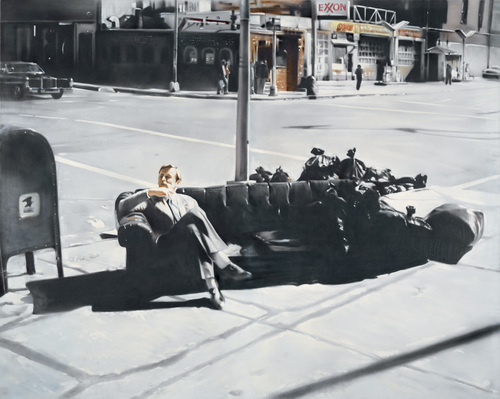
I really enjoyed our field trip to the Moma and the Whitney. I was actually surprised at what is considered art. Dear Painter, Please Paint for Me, made in 1981 by Martin Kippenberger, caught my interest. When we first viewed this painting in the MOMA museum, I didn’t know what to make of it. I actually didn’t understand the subject or reason why this man was sitting on a couch piled with trash bags. After finding out that Kippenberger didn’t even take the photo or paint it himself, it made really made me frustrated. He got created with an entire room filled with art work that he didn’t even create. They were only his ideas, not his actual art work. Although Kippenberger didn’t paint it himself, I loved the way Verner made the painting off center, blurry, and had no signature.
I do consider this a great work of art. At least Kippenberger credited Verner with the creation of this painting. I do find it very odd that he has an entire room filled with three huge paintings that he didn’t create at all, merely his idea that he told someone. I also thought it was interesting that Kippenberger was a drunk and Verner painted this painting in almost a blurry vision and with big juicy strokes. From far away it seemed to appear very clear, but up close it was blurry. I also thought it was interesting as to why Kippenberger wanted a painting of himself sitting on a black couch surrounded by trash bags. My opinion is that he was thrown out of his apartment with his purchased couch and trash bags filled with other belongings. I believe that MOMA has this exhibit displayed because of his story. He had great ideas and vivid paintings, but maybe couldn’t create them himself. Also they stress that Verner painted them, so he’s just as famous, if not more famous for painting these pictures on canvas.

Images from:

Modern Art


Pop art was an art movement in the late 1950s and 1960s that reflected everyday life and common objects. Pop artists blurred the line between fine art and commerical art. Pop artists used a form of obstract expressionism, which evoked their emotions through line, color, shape, form, and texture. They also recreated photographs, comic strips, and advertisements. Andy Warhol was a major abstract artist during this time. Contents of Time Capsule and Marilyn Monroe are perfect examples of Warhol's abstract pop art works.

Images from:

Wednesday, June 3, 2009

Post-Impressionism


Post-Impressionism was the French art movement tha immediately followed Impressionism. The artists who were a part of this movement showed a greater concern for structure and form than did the Impressionist artists. Still Life with Peppermint Bottle was a perfect example of Post-Impressionist art. The strong, thick outlines gives the painting quality and adds variety. Vincent van Gogh used techniques from the Impressionist period, but later transferred his style by painting large, flat areas of color, and tilted his compositions to create a strange new kind of perspective. Bedroo, at Arles shows this.

Images:

Impressionism


Impressionism is an art style that tried to capture an impression of what the eye sees at a given moment and effect of sunlight on the subject. Paintings were made up of small dabs or spots of color, when viewed at a distance they blend together to create the desired effect of a complete picture. Famous artists during this time period were Monet, Renoir, and Degas. Monet's Rouen Cathedral showed his seperate brushstrokes that looked like an uneven mixture of colored dabs and dashes, but viewed from a distance they looked blended together. LeMoulin da la Galette by Renoir showed his applied dashed that seemed to blend together. Hard precise outlines were replaced by blurred edges during this period.

Images from:

Realism


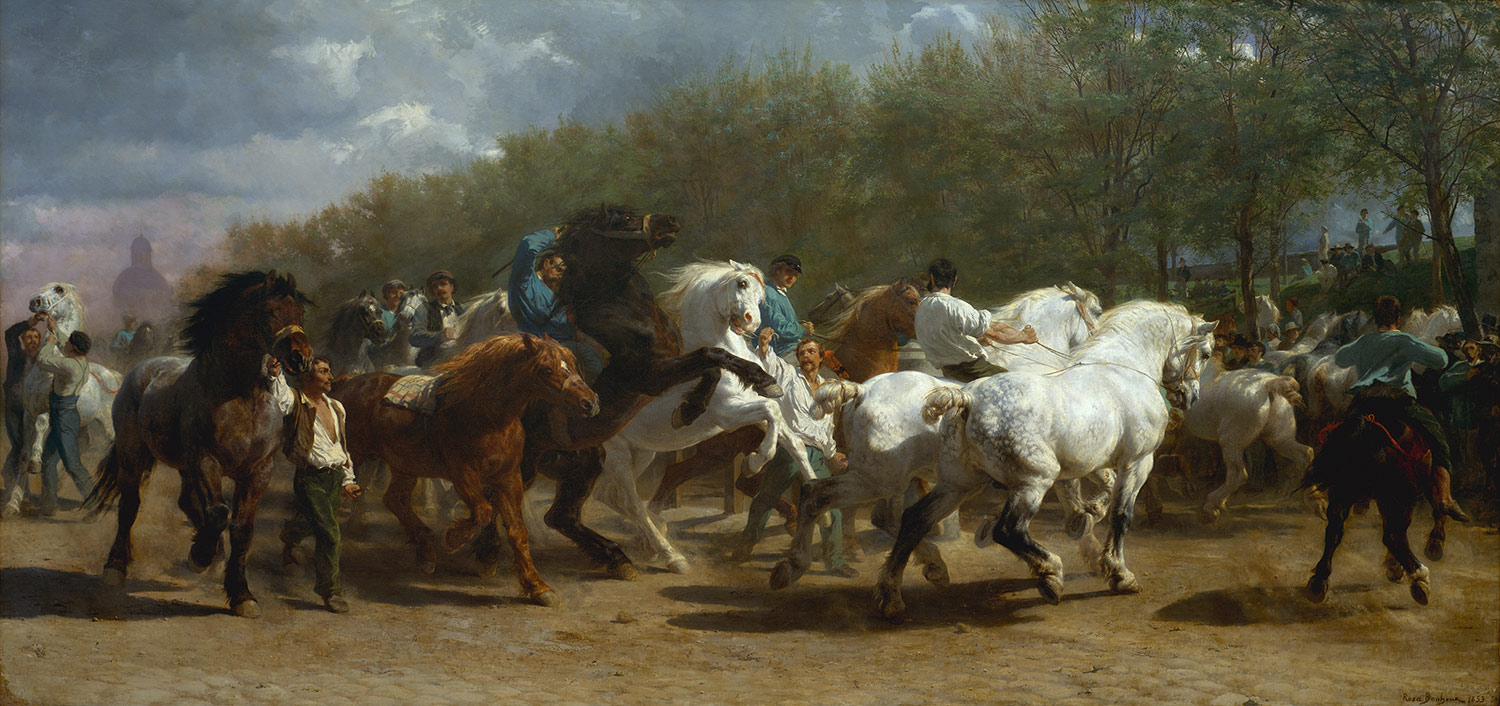
This period, known as Realism, represented everyday scenes and events as they actually looked. In Courbet's Burial at Ornans he had his friends pose for the painting because they were important to him and his life. This work shows real people behaving the way real people behave. On the other hand, an artist by the name of Manet was more interested in how to paint than in what to paint. In, The Railway, Manet avoided details because he wanted his picture to show what the eye could take in with a quick glance. Rosa Bonheur, on the other hand, painted The Horse Fair, which as a result is a thrilling blend of movement, drama, and reality that echoes the accomplishments of both Romantic and Realist artists.

Images from:

Romanticism


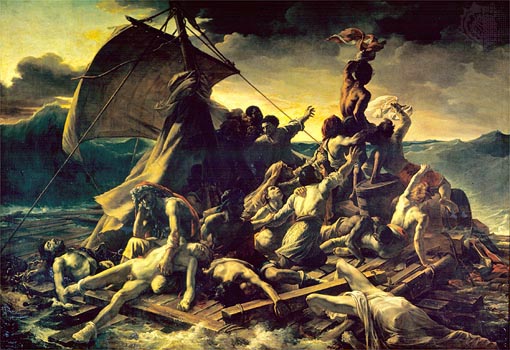
Romanticism portrayed dramatic and exotic subjects perceived with strong feelings. The most famous artists during this time period include Theodore Gericault and Eugene Delacroix. Raft of the Medusa shows a dramatic, contemporary event as it actually happened. The diagonal design, twisting figures, strong emotion, and dramatic use of light are important characteristics of the Romantic style. Gericault's, The Lion Hunt, shows his love of dramatic action and exotic settings. The swirls of color were very evident in this work.

Images from:

Neoclassicism


Neoclassicism sought to revive the ideals of ancient Greek and Roman art, and was characterized by balanced compositions, flowing contour lines, and noble gestures and expressions. Neoclassical artists at first sought to replace the sensuality and what they viewed as the triviality of the Rococo style with a style that was logical, solemn in tone, and moralizing in character. The most famous artists of this time period were Jacques-Louis David, Marie-Louise- Elisabeth Vigee-Lebrun, and Jean-Auguste-Dominique Ingres. One of the most famous paintings of the Neoclassicism time period is the Death of Marat by David. He portrayed his tribute to Jean-Paul Marat, one of the major figures in the French Revolution. The Oath of the Horatii by David showed what was occurring during this period. David used great line and focus in this painting.


Images from:


Baroque and Rococo Art

ROCOCO PAINTINGS


BAROQUE PAINTINGS


BAROQUE

Baroque art was a style characterized by movement, vivid contrast, and emotional intensity. Some great artists of this time were Francesco Borromini, Gianlorenzo Bernini, Michelangelo da Caravaggio, Artemisia Gentileschi, and Peter Paul Rubens. Throughout the Baroque period, sculptors showed the same interest in movement, contrast, and variety as did architects. The Entrance of St. Ignatius into Paradise by Fra Andrea Pozzo captured the moment of highest drama and excitement. Sculptors of this time showed the skills of complex modeling and reproducing different textures. Sculptors of this time period made their figures appear to move about freely within the space. An example of this is by Gianlorenzo Bernini entitled The Ecstasy of St. Theresa.

Images from:


ROCOCO

Rococo art replaced Baroque art at the beginning of the 18th century. It placed emphasis on carefree life of the aristocracy rather than on grand heroes or pious martyrs. The painting style of this time was focused on love and romance. Antoine Watteau was considered to be one of the first Rococo painters. Once of his many famous works was his painting entitled Embarkaton for Cythera. Another painting by Jean-Honore Fragonard, The Swing, portrayed the Rococo characteristics. Thomas Gainsborough, an English Rococo painter, was admired by his delicate brushwork, and rich glistening pastel colors. In the Blue Boy, Gainsborough showed shining silks and buckles, fragile lace, and ruffles of fashionable clothing.
Images from:

Pysanky Egg Art


The art of Ukrainian eggs, also known as pysanky egg art, is a traditional craft that has been practiced for thousands of years. The process is quite metticulous. They are made by painting a wax design on the egg, letting it harden which only takes a few seconds, then dipping them in a colored dye. After the first coat of dye dries, more wax is placed on the egg to allow the first color to remain. Generally one is suposed to work from light to dark colors. This process continues until the artist gets the achieved effect of multi-colored designs. Afterwards, the wax is melted off by a candle or small flame, leaving white where the wax once covered the egg shell. Various patterns and colors also symbolize different qualities and emotions. They are now referred to as good luck charms. Overall, I enjoyed this egg-dyeing process and think these eggs are a beautiful way to carry on cultural traditions.


Images from:

Sunday, April 26, 2009

Renaissance Art


The Renaissance was a period of “rebirth”. Many artists such as Michelangelo, Leonardo da Vinci, and Botticelli showed their infamous creations through their artwork. Some of my favorites that we’ve studied were the Mona Lisa and the ceiling of the Sistine Chapel, which consisted of many different paintings telling the story of the bible. I thought it was interesting that Michelangelo didn’t consider himself a painter. In his mind he was a sculptor and was actually offended that he was asked to paint something so massive, especially on a ceiling. Leonardo da Vinci was considered the ultimate Renaissance man where he was not only a skilled painter, but also a mastermind in engineering, architecture, and even musician. My favorite work of his is the Mona Lisa. Some believe the painting was a portrait of himself in female form.
Imagines from:


Thursday, March 12, 2009

MARDI GRAS!

http://blogs.citypages.com/pscholtes/images/Mardi%20Gras%20Indian%202007.JPG
I really enjoyed our unit on Mardi Gras. Even though I don't give up anything for Lent, I thought it was a great idea that we were assigned to create a day of our own that we would have to give up for the Lent period. During this huge party before Lent, people party it up and enduldge in a full day of pigging out, dancing, and singing. For my day I created Singing Day and made cup cakes with little music notes on them with Kelsey who had Chocolate Day. I liked everyone elses ideas of how they would spend their day, especially Mykul's short/rubics cube day. I thought it that creating our own day was a great way to show the class what we enjoyed participating in. I also thought creating our own Mardi Gras mask was a fun way to top off the lesson.

Gothic Art

http://upload.wikimedia.org/wikipedia/commons/e/e4/Notre_dame-paris-view.jpg
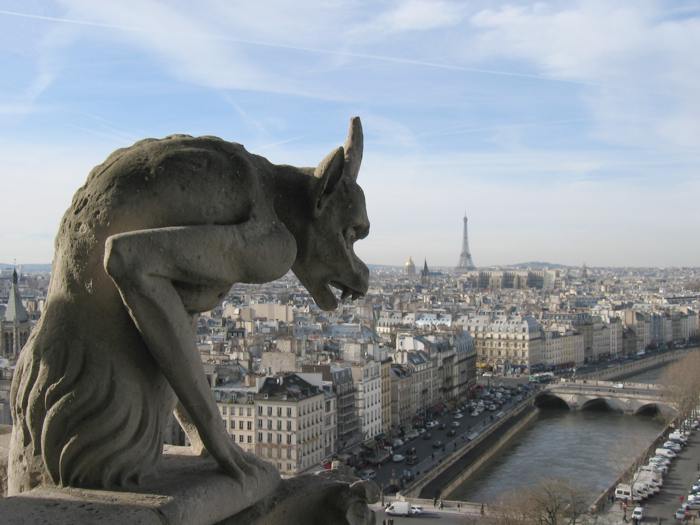
I really enjoyed studying gothic art, considering that I've seen a real gothic style cathedral when I went to Paris. (Notre Dame) Since my group picked this cathedral for our project, I found out that half of this structure was built in roman style and finished in gothic style. This period lasted for about three centuries all the whole changing from roman to gothic style. The outside shows its gothic style with gargoyles perching off of the roof and its pointy exterior. The inside however is filled with arches and beautiful stained glass. I really liked making the rose windows. Everyone created their own style and filled them with bright colored "glass". I found gothic art to be very interesting because it was something very unheard of that appeared during that time period.

Early Christianity


http://www.ubcvault.ca/images/feature/p187.jpg

During the Early Christianity unit, illuminated manuscripts were our main focus of study. These manuscripts depicted stories from the Christian religion, focusing on the stories of the Bible. I really enjoyed making my illuminated manuscript. I found them very relaxing, considering most of my design was curvy lines and swirls. I really enjoyed choosing my own inspirational quote to calligraphy inside my frame. What's amazing to me is how far back the original manuscripts were designed and created. Creating my own manuscript made me realize how precious, beautiful, and intricate an original illuminated manuscript was and how long it too to create. They truly are a work of art.


Friday, January 23, 2009

Byzantine Art


Byzantine Art is full of mosaics, just as the Hagia Sophia is pictured above. The inside of this dome temple, supported by its massage piers, is such an amazing and beautiful creation. This temple is created with the combined aspects and architectural design of the Roman's and the Greeks. Most mosaics were designed and made to show some aspect of the Christian religion.