Thursday, June 4, 2009

New York City Field Trip


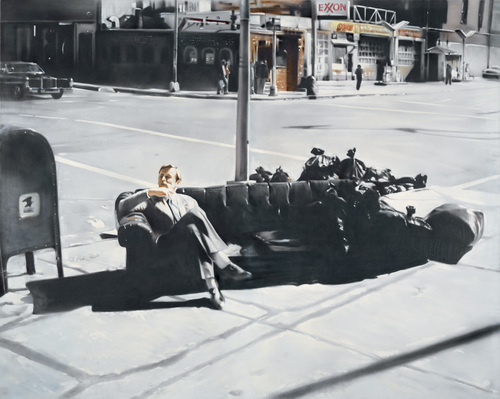
I really enjoyed our field trip to the Moma and the Whitney. I was actually surprised at what is considered art. Dear Painter, Please Paint for Me, made in 1981 by Martin Kippenberger, caught my interest. When we first viewed this painting in the MOMA museum, I didn’t know what to make of it. I actually didn’t understand the subject or reason why this man was sitting on a couch piled with trash bags. After finding out that Kippenberger didn’t even take the photo or paint it himself, it made really made me frustrated. He got created with an entire room filled with art work that he didn’t even create. They were only his ideas, not his actual art work. Although Kippenberger didn’t paint it himself, I loved the way Verner made the painting off center, blurry, and had no signature.
I do consider this a great work of art. At least Kippenberger credited Verner with the creation of this painting. I do find it very odd that he has an entire room filled with three huge paintings that he didn’t create at all, merely his idea that he told someone. I also thought it was interesting that Kippenberger was a drunk and Verner painted this painting in almost a blurry vision and with big juicy strokes. From far away it seemed to appear very clear, but up close it was blurry. I also thought it was interesting as to why Kippenberger wanted a painting of himself sitting on a black couch surrounded by trash bags. My opinion is that he was thrown out of his apartment with his purchased couch and trash bags filled with other belongings. I believe that MOMA has this exhibit displayed because of his story. He had great ideas and vivid paintings, but maybe couldn’t create them himself. Also they stress that Verner painted them, so he’s just as famous, if not more famous for painting these pictures on canvas.

Images from:

Modern Art


Pop art was an art movement in the late 1950s and 1960s that reflected everyday life and common objects. Pop artists blurred the line between fine art and commerical art. Pop artists used a form of obstract expressionism, which evoked their emotions through line, color, shape, form, and texture. They also recreated photographs, comic strips, and advertisements. Andy Warhol was a major abstract artist during this time. Contents of Time Capsule and Marilyn Monroe are perfect examples of Warhol's abstract pop art works.

Images from:

Wednesday, June 3, 2009

Post-Impressionism


Post-Impressionism was the French art movement tha immediately followed Impressionism. The artists who were a part of this movement showed a greater concern for structure and form than did the Impressionist artists. Still Life with Peppermint Bottle was a perfect example of Post-Impressionist art. The strong, thick outlines gives the painting quality and adds variety. Vincent van Gogh used techniques from the Impressionist period, but later transferred his style by painting large, flat areas of color, and tilted his compositions to create a strange new kind of perspective. Bedroo, at Arles shows this.

Images:

Impressionism


Impressionism is an art style that tried to capture an impression of what the eye sees at a given moment and effect of sunlight on the subject. Paintings were made up of small dabs or spots of color, when viewed at a distance they blend together to create the desired effect of a complete picture. Famous artists during this time period were Monet, Renoir, and Degas. Monet's Rouen Cathedral showed his seperate brushstrokes that looked like an uneven mixture of colored dabs and dashes, but viewed from a distance they looked blended together. LeMoulin da la Galette by Renoir showed his applied dashed that seemed to blend together. Hard precise outlines were replaced by blurred edges during this period.

Images from:

Realism


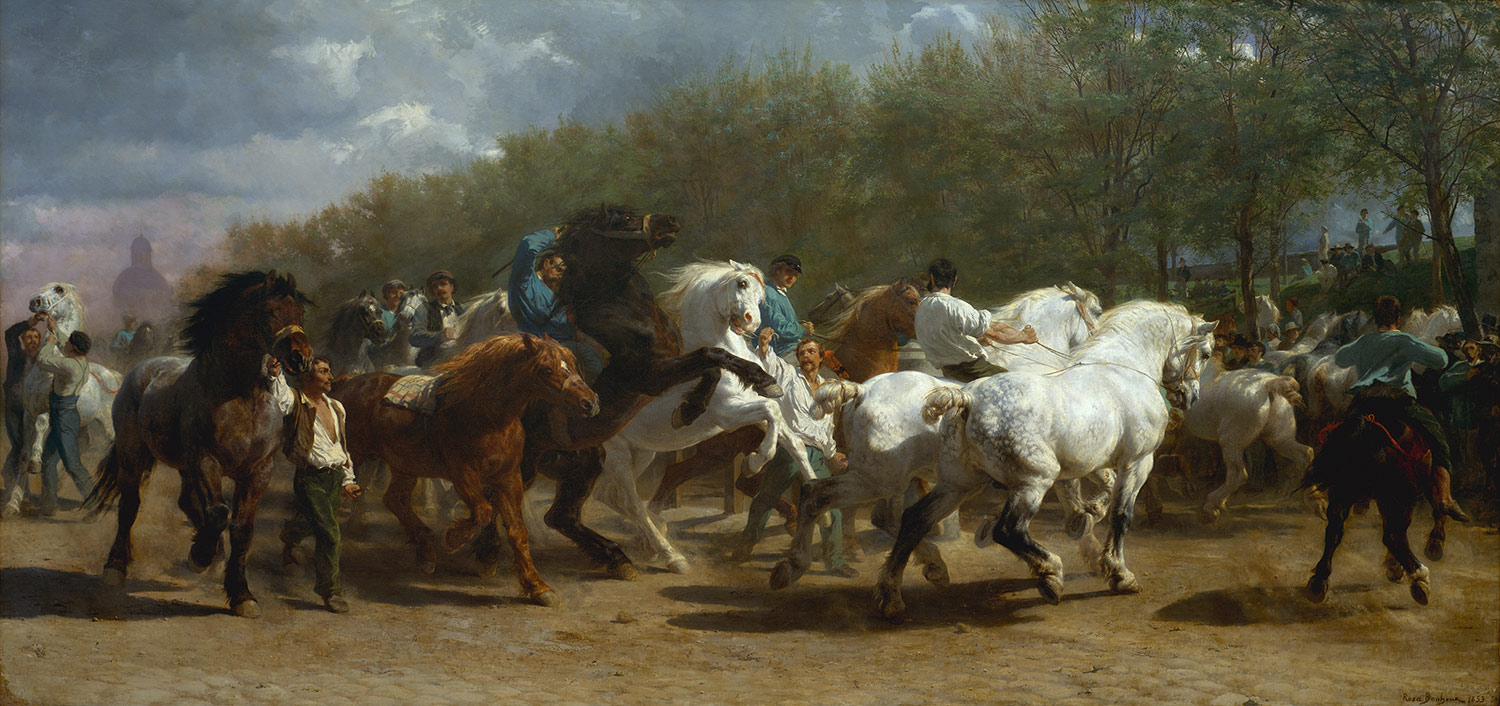
This period, known as Realism, represented everyday scenes and events as they actually looked. In Courbet's Burial at Ornans he had his friends pose for the painting because they were important to him and his life. This work shows real people behaving the way real people behave. On the other hand, an artist by the name of Manet was more interested in how to paint than in what to paint. In, The Railway, Manet avoided details because he wanted his picture to show what the eye could take in with a quick glance. Rosa Bonheur, on the other hand, painted The Horse Fair, which as a result is a thrilling blend of movement, drama, and reality that echoes the accomplishments of both Romantic and Realist artists.

Images from:

Romanticism


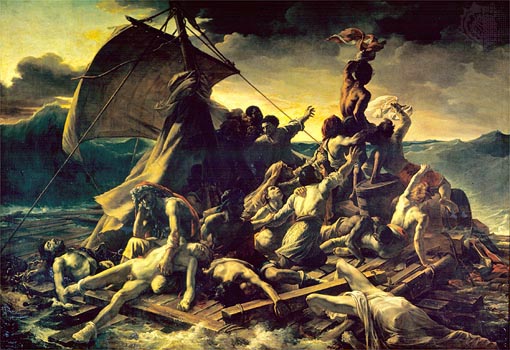
Romanticism portrayed dramatic and exotic subjects perceived with strong feelings. The most famous artists during this time period include Theodore Gericault and Eugene Delacroix. Raft of the Medusa shows a dramatic, contemporary event as it actually happened. The diagonal design, twisting figures, strong emotion, and dramatic use of light are important characteristics of the Romantic style. Gericault's, The Lion Hunt, shows his love of dramatic action and exotic settings. The swirls of color were very evident in this work.

Images from:

Neoclassicism


Neoclassicism sought to revive the ideals of ancient Greek and Roman art, and was characterized by balanced compositions, flowing contour lines, and noble gestures and expressions. Neoclassical artists at first sought to replace the sensuality and what they viewed as the triviality of the Rococo style with a style that was logical, solemn in tone, and moralizing in character. The most famous artists of this time period were Jacques-Louis David, Marie-Louise- Elisabeth Vigee-Lebrun, and Jean-Auguste-Dominique Ingres. One of the most famous paintings of the Neoclassicism time period is the Death of Marat by David. He portrayed his tribute to Jean-Paul Marat, one of the major figures in the French Revolution. The Oath of the Horatii by David showed what was occurring during this period. David used great line and focus in this painting.


Images from: