Wednesday, November 19, 2008

Asian Art


This week was probably the most interesting unit we've studied to this date. I found the history and artwork so unique. The main focus of Asain art was to promote peace and tranquility. This type of atmosphere promoted the calming artwork of the bamboo that we're currently still painting. During this week of asian art, I found that china and japan are quite similar. I really liked the use of line in both chinese and japanese art. It's drawn crisp and straight, giving it that unified look. I found it interesting that they use calligraphy to stamp their bamboo paintings. It shows who worked on the painting and that their seal is their own design. I also really liked the wash techique we learned yesterday. It gives the painting such a life like mood and feeling to add to the peacefulness of chinese and japanse art. Here's a picture :


Chinese and Asian art are so similair yet completely different. What I really loved about the Japanese art that we studied was that most peices were connected in a way of emotion and feeling. They were very powerful and told a story. This picture is the Great Wave by Hokusai. We talked about the tips of the waves being pointed downward and curled into little spikes showing that intense fearful emotion. I also loved how Mt. Fuji can be seen in the back, just as it was in many of his works. The use of perspective also distingushed that difference between Chinese and Japanese art as well. The use of wood block prints were also very common.


Thursday, November 13, 2008

Greek and Roman Art

Inside
Outside
I figured that I would just include a couple of pictures of my own that I took while I was in Rome this past summer. I loved seeing all of the old buildings and structures. I couldn't believe that they were still standing after all of those thousands of years. The Colesseum was originally its own city. The most amazing thing was the architecture and design of the structures we've learned about. For that time period, they were so advanced and so detailed, without any modern tools.

Here is a picture of the Parthenon atop the Acropolis in Greece. This is considered the house of Athena. When I visited Greece this past summer, I was in complete shock that this building was still standing. The three types of columns that are among the most popular in column design are doric, ionic, and corinthian. Doric is the most simple, ionic is shaped into double scrolls that look like the horns of a ram, and corinthian is the most decorated and elongated with leaves.


I thought that this week during our research about our chosen god or goddess was very helpful. It was interesting to get to know the different types of powers of different gods and goddesses. Since I was working next to Kelsey B these past two days she was sharing some of her information about her goddess to me and I found that her goddess Aphrodite and my goddess Hera are the wives of Zeus. I can't wait to make our toga's tomorrow. I bought peacock feathers because the "eye" of the feather symbolizes with Hera's well known beautiful eyes. I can't wait to eat either! Kelsey and I are bringing in baklava! Here is a picture of my goddess, Hera:


Thursday, October 30, 2008

African Art

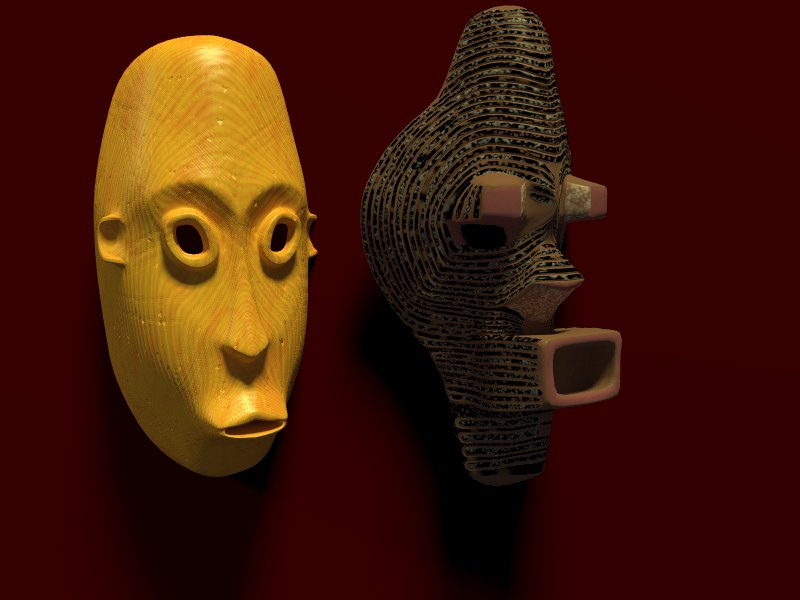
Men wore masks for cultural rituals. They would often be seen wearing elebrate masks as these shown here.
http://hof.povray.org/images/mask26.jpg


During the week that we learned about African art, I found their culture quite interesting. What I really liked about this unit was the way the africans cut there faces and made them like tattoos. It's so different from our culture. I like how it defines their way of life and the way they show respect to people above them. Here is an image I found and liked on African art.


In benin artwork, size bases power. The bigger a figure or person is in a painting usually depicted their physical importance. Yoruba artwork, for example, created pictures of rulers. By their massive size, you can see that they have a higher importance and authority.

Tuesday, September 30, 2008

Egyptian Art

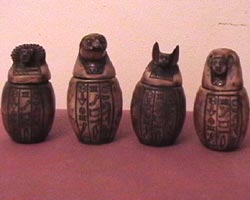
Picture: http://www.bibleandscience.com/products/images/canopicjars.jpg


During last week and this week of learning about Egyptian Art, so many things I never knew before have come to my attention. I never knew that the ancient Egyptians took out certain body parts and placed them in special jars and it never occurred to me how old these tombs really were. What amazes me is that they're still there, whether in museums or still inside a huge pyramid. Last week we looked at different pyramids through out Egypt and learned about the actual size they were, some up to 45 stories high made with over 2 million bricks! That's amazing! If something were built like that today it would turn many heads, so imagining it being built all that time ago seems almost impossible. I especially like the project we're making for this unit. The barbie's make a perfect size mummy!


Sunday, September 21, 2008

Prehistoric Art

Here is a photo of a bison painted on the walls of the Lascaux Caves located in France.


I found the unit of Prehistoric Art to be quite interesting to my surprise. What really shocked me was my ability to actually draw something and not have it look like a train wreck. Even if a peice of art doesn't look spectacular, it really doesn't matter. I was just really proud that I could draw my little gray elephant that's on display for the whole school to see. After learning where art pretty much originated and how paint and techniques were developed, it made me realize that those concepts are still used today, just modernized. I really like the peice that we made with our homemade paint. Even though it was only jello and some spices, it turned out so pretty and I was so surprised to how much I'm starting to love art. This week during class, I learned that the aspects and background of Prehistoric Art are really the back bone of today's methods and patterns. Between looking at the caves at Lascaux and of those at Chauvet, they all had one thing in common: simplicity. But just because they were simple doesn't mean they weren't so magnificently created. The way they showed movement by drawing that echo effect or the way they captured lighting by shading, all showed such an advancement in their society and in the art world.


Tuesday, September 9, 2008

Thunderstorm

The rain falling down lightly at a slant to the ground makes a peaceful scene. The sound of the rain hitting the ground makes a calming tone to the scene. The strikes of lightening and booming thunder constrast to the smoothing sounds of the rain. The popping rain off of the roof creates some sort of exilerating emotion to the calming rain against the ground. I also think the browns and greens creates a feeling of calming and the season of autumn nearing.

I forgot the link I got it from, so here :)


http://www.pcmag.com/encyclopedia_term/0,2542,t=digital+media&i=41342,00.asp
(cited)


This is a picture of when I was in Capri, Italy this summer. I used digital media by downloading it to the computer and posting it on my blog. :)

Monday, September 8, 2008

Digital Media

Digital media usually refers to electronic media that work on digital codes. Things such as cell phones, digital video, digital television, and the internet are some examples of digital media. In the art world, digital art has become popular by starting with a traditional art piece and using the internet or some sort of media technology to combine the two into one.